
The word “Neuropathy” literally means a problem with your nerves (“neuro” means nerves, and “opathy” means problem). The most common symptoms someone with this condition may experience are constant or shooting pain, burning, numbness, and tingling. Peripheral neuropathy simply means that the symptoms are in your feet or hands (parts of your body away from the center).
Peripheral Neuropathy can be stopped, and it can be reversed to a certain degree. The protocol we use has been around for many years, and has helped tens of thousands of people regain their quality of life. This program is different from others because we do not use drugs, injections, or surgery to treat. It is 100% non-invasive, and has no side effects.
If your exam shows your nerves are still viable, and you commit fully to your care by doing what Dr. Wheeler recommends, you will show improvements over time. If your exam shows that the nerves are no longer viable, and there is nothing we can do, he will let you know right away. We are not here to waste your time or your finances.
How Do Nerves Work?
First off, we have to know how our nerves work, then we can talk about what could be going wrong. Your body has two types of nerves, sensory (for carrying messages to the brain from the rest of the body) and motor (for carrying messages from the brain to the rest of the body).
Take a look at the image here to help you understand
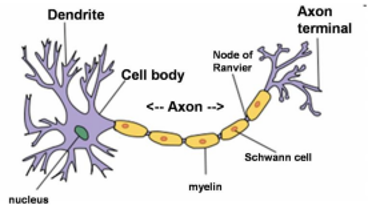
the next few paragraphs about how your nerves work.
Sensory Nerves:
These nerves work by converting a stimulus (like heat or pressure) into an electrical signal at the very end of the nerve which is called the dendrite. When the signals get to the body of the nerve cell, it determines if the signal should be ignored or sent up to the brain. From there, the signal is sent from one nerve cell to another through a pathway called the axon.
Nerves do not actually touch one another; they are separated by a fluid-filled sack called the synaptic junction. The signals jump across this fluid to get from cell to cell.
When the signals make it from the peripheral nerves (the ones from the arms, legs, etc.) to the spine, they connect with the synaptic junctions of the central nerves (in the spine and brain) and the message is delivered up to the brain for evaluation.
Motor Nerves:
The brain is made to determine the proper steps to take to fix any problems the body may experience (pain from stepping on a nail, burning your finger, etc.) by sending messages to the muscles, telling them to move.
The brain also keeps track of the blood and lymph flow of the body to make sure the nerves stay healthy. It does this by opening or closing blood vessels, adjusting the heart rate, controlling the body’s temperature and breathing rate, as well as how it reacts to stress.
What happens when the nerves don’t work properly?
If the dendrites do not have enough blood flow to or from them, they cannot function properly to accurately get the signal where it needs to go.
If the body of the cell has been poisoned by toxins (from medications or other sources), it results in the cell being overly sensitive. This could mean that it sends pain signals when there is no real pain present, or maybe it could ignore pain signals that are there, resulting in numbness.
If the axon is damaged from a trauma or thinning of the protective covering (called the myelin sheath), then the signal cannot travel along the path to the synaptic junction, which means it can’t get to another cell.
Any one of these parts having a problem can result in the nerve not functioning properly…often when a patient presents with neuropathy, it is a combination of these factors.
What Causes Neuropathy?
There are several things that could be causes for the symptoms of Neuropathy you may be experiencing.
The myelin sheath can be thinned or damaged with the overuse of cholesterol medications. When these drugs finish clearing out the cholesterol from your arteries and veins, they go looking for other areas where cholesterol may be concentrated, one of which is the myelin sheath. The drugs start to eat away that protective layer, which can cause the nerves to ‘short circuit’.
Spinal Stenosis (the narrowing of the space between the bones in the spine), can pinch the nerves that extend from the spinal cord to the rest of the body. This issue can be from the spine laterally flexing (tipping to the side), being compressed, from the weakening of muscles so the spine can no longer stay in a straight line, or from the tightening of muscles in the low back, buttocks, or thighs, putting pressure on the sciatic nerve. This pressure, whatever the cause is, disrupts the nerve signals and/or causes ischemia (the loss of blood flow) which inhibits the removal of toxins and can reduce the amount of oxygen in the nerve cells. The pressure can also ‘bend’ the dendrites and axons of the nerves, which disrupts the signal transfer from cell to cell.
One of the devices we use in the treatment protocol sends a much larger signal down the nerve cells to help reset the nodes back to their normal state – this helps your symptoms improve because the overactive nerves (causing the pain or discomfort) can relax, the underactive nerves (causing the
numbness or balance issues) can start to work normally again, and the nerves overall can start the healing process.
Below, is a list of some of the other potential causes.
• Diabetes – this causes blood loss, sensitivity, and numbness in the nerve endings, blood vessels, and capillary endings in the skin.
• Toxins – statin drugs, Chemotherapy, Agent Orange, smoking, Vitamin B deficiencies, some prescription medications, aluminum, and fluoride all cause damage to the nerve cells • Physical impingements in the spine or inflammatory swelling in the limbs
• Surgical procedures or traumatic injuries resulting in an actual break in the nerve path • Obstruction in the lymphatic circulation system – causing toxins to accumulate • Excessive stress or inflammation in the body
• Demineralization of the synaptic junctions between nerve cells
• Dysfunctional nerve waveforms – signals are too strong or too weak
• Muscle atrophy in the calves from disuse – reduces blood and lymph circulation • Poor sleep patterns – results in low oxygen levels in nerves
What Needs to Happen to Relieve Neuropathy?
There are 3 main things a nerve needs to be able to function properly. Blood flow, Oxygen, and Nerve flow. The neuropathy treatment protocols we follow help to improve all three of these areas as well as many others.
• Blood flow needs to be restored to the skin of the symptomatic area as well as from that area back to the heart.
• Lymphatic circulation needs to be restored or improved to help the body flush out toxins. • Physical impingements need to be identified and then reduced or eliminated completely. • The nerve path needs to be restored, and the synaptic junctions need to be re-mineralized. • The calf muscles need strengthening to help improve the flow for the blood and lymphatic systems.
• Nerve cells need to be re-educated to better create and transmit healthy waveforms • The electrical impulse needs to be strong enough to jump the gap between nerves • Sleep and stress management to provide a proper nerve healing environment • Reduction of the intake of toxins as much as possible – with help from medical providers
Our Treatment Goals
1. To Increase the blood supply to the nerves
2. To Repair and Re-educate the nerves
3. To Increase the blood flow to the feet or hands
4. To Improve balance and mobility